
Ledger vs. Trezor (2026): Which Hardware Wallet Should You Choose?
Updated October 13, 2026. A plain-English comparison of the two best-known hardware wallets, based on each maker’s published information.
Affiliate disclosure: The “Buy” buttons on this page are affiliate links. We may earn a commission if you buy, at no extra cost to you. It doesn’t change what we write. We have not tested these devices ourselves. See our full disclosures.
The short answer
Choose Ledger if you want a polished app, broad asset support and a choice of screen sizes and designs. Choose Trezor if open-source code you can inspect matters most to you. Both are established devices that keep your private keys offline. Neither can protect you if you give away your recovery phrase.
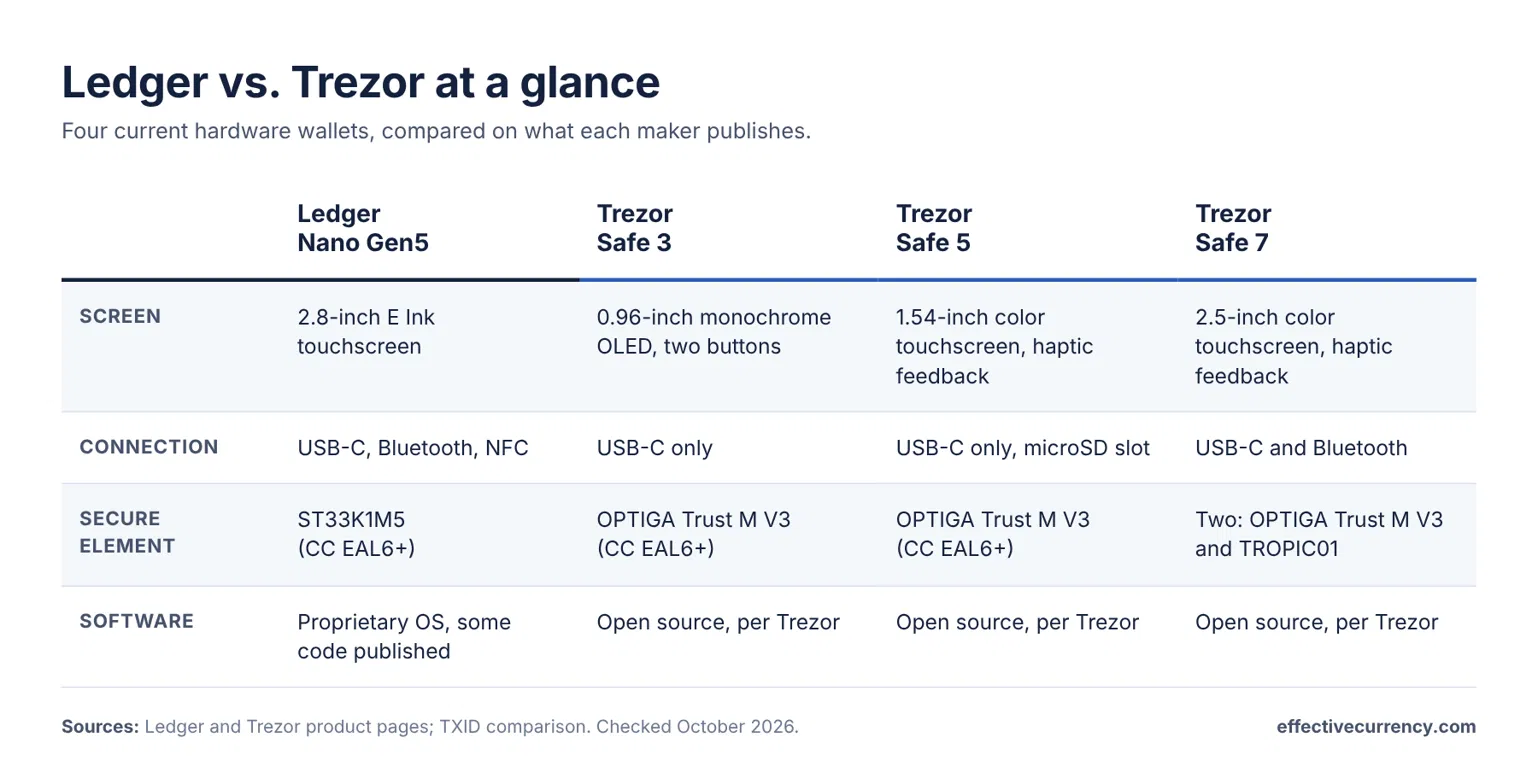
Side by side Ledger vs Trezor
| Ledger | Trezor | |
|---|---|---|
| Current models listed by the maker | Stax, Flex, Nano Gen5, Nano classics | Safe 7, Safe 5, Safe 3 |
| Source code | Proprietary operating system. Some code is published. | Describes its code and design as fully open source |
| Secure element chip | States that all its wallets use one | Newer models include one. Older models did not. Check the model. |
| Supported assets (maker’s wording) | 1000s of cryptocurrencies in Ledger Wallet; others work through third-party wallets, which Ledger does not guarantee | Advertises “1000s of coins and tokens” |
| Companion app | Ledger Wallet | Trezor Suite |
| Connection | Ledger Nano Gen5: USB-C, Bluetooth and NFC (per Ledger); other Ledger models vary. Trezor Safe 3 and Safe 5: USB-C only. Trezor Safe 7: USB-C and Bluetooth. | |
Asset counts aren’t directly comparable. Brands count tokens and networks differently, and many assets work through third-party apps rather than the maker’s own software. Always confirm that the specific coin you hold is supported before you buy.
Ledger
Strengths
- Several designs and screen sizes to choose from
- Very broad asset support through Ledger Wallet and partner apps
- Secure element chip across the range, according to Ledger
Things to weigh
- The operating system is proprietary, so you rely on Ledger’s own security claims and outside audits.
- Ledger offers an optional, paid seed-backup service called Ledger Recover. It is opt-in, but some users object to it on principle. Read the terms before deciding.
- In 2020 Ledger disclosed a breach of customer contact data, which was followed by phishing campaigns. Treat any message that appears to come from Ledger with suspicion.
Trezor
Strengths
- Open-source firmware and software that anyone can inspect
- Trezor Suite is straightforward for beginners
- A long track record, with its first device released in 2013
Things to weigh
- Specs differ a lot between models. An older Trezor and a current one are not the same product, so compare model to model.
- Some coins and tokens need third-party wallet software.
- Open source makes code reviewable. It does not by itself make a device safe.
- The Safe 7 adds a second secure element, TROPIC01. In June 2026, researchers from Ledger’s security team and the chip maker Tropic Square reported a lab attack on it. Trezor says user funds and keys are not at risk. Ledger is a competitor, so read our Trezor comparison and Trezor’s own statements.
Open source vs. closed source: what it really means
Open code lets independent researchers check what a device is doing, which is why some people prefer Trezor. Closed code can still be audited, and a secure element chip is designed to resist physical attacks that general-purpose chips may not. Neither approach is automatically safer. For most people the larger risks are human: a fake support message, a phishing site, or a recovery phrase typed into the wrong place.
Who should choose which
- You want the most polished app and the broad asset support: start with Ledger.
- You want open code you can inspect: start with Trezor.
- You only hold Bitcoin and a few major coins: either works. Compare the specific models.
- You hold many smaller tokens: check support for each one on both brands first.
Before you buy
- Buy only from the maker’s official site or an authorized reseller. Never buy a used device, or one that arrives already opened or with a recovery phrase already written down.
- Never type your recovery phrase into a website, app or message. No real support team will ask for it. See Seed Phrase Do’s & Don’ts.
- Send a small test transfer first. See How to Test Transfers Safely.
- Plan for recovery before you need it. See Self-Custody & Recovery.
Where to buy
Both buttons are affiliate links. Prices change often, so check the current price and model details on the maker’s page.
Frequently asked questions
Are hardware wallets completely safe?
No. They keep your keys offline, which removes many online threats, but they can’t protect you if you reveal your recovery phrase, approve a malicious transaction, or lose your backup.
What if the company goes out of business or I lose the device?
Your funds live on the blockchain, not in the device. With your recovery phrase you can restore access using a new device or compatible software. Store the phrase offline and keep it private.
Is a hardware wallet worth it for small amounts?
That depends on what you can afford to lose and how much you want to avoid exchange and online-wallet risks. Many people start using one once the amount matters to them.
Do I have to buy through your links?
No. You can go directly to either maker’s site. If you use our links, we may earn a commission at no extra cost to you.
Sources
- Ledger: product lineup and security claims (checked October 2026)
- Trezor: product lineup and open-source statements (checked October 2026)
- TXID, Coldcard, Jade, Trezor, Ledger: A Security Model Comparison (independent; states no affiliations). Checked October 2026.
- The Block, Ledger researchers find flaw in chip used by Trezor Safe 7; Trezor says user funds safe, June 2026. Checked October 2026.
- Decrypt, Hacked Ledger database dumped on Raidforums, December 2020, on the 2020 Ledger data breach. Checked October 2026.
Education only, not financial, legal or tax advice. No device can guarantee the safety of your funds. Product details change, so confirm specifications and prices with the manufacturer before you buy.
Read next: Best Hardware Wallet for Beginners (2026), covering Ledger, Trezor and Bitcoin-focused options.
Read next: Trezor Safe 3 vs Safe 5 vs Safe 7, covering the differences between Trezor’s three current models.